July 2026 / RUNNING & WALKING
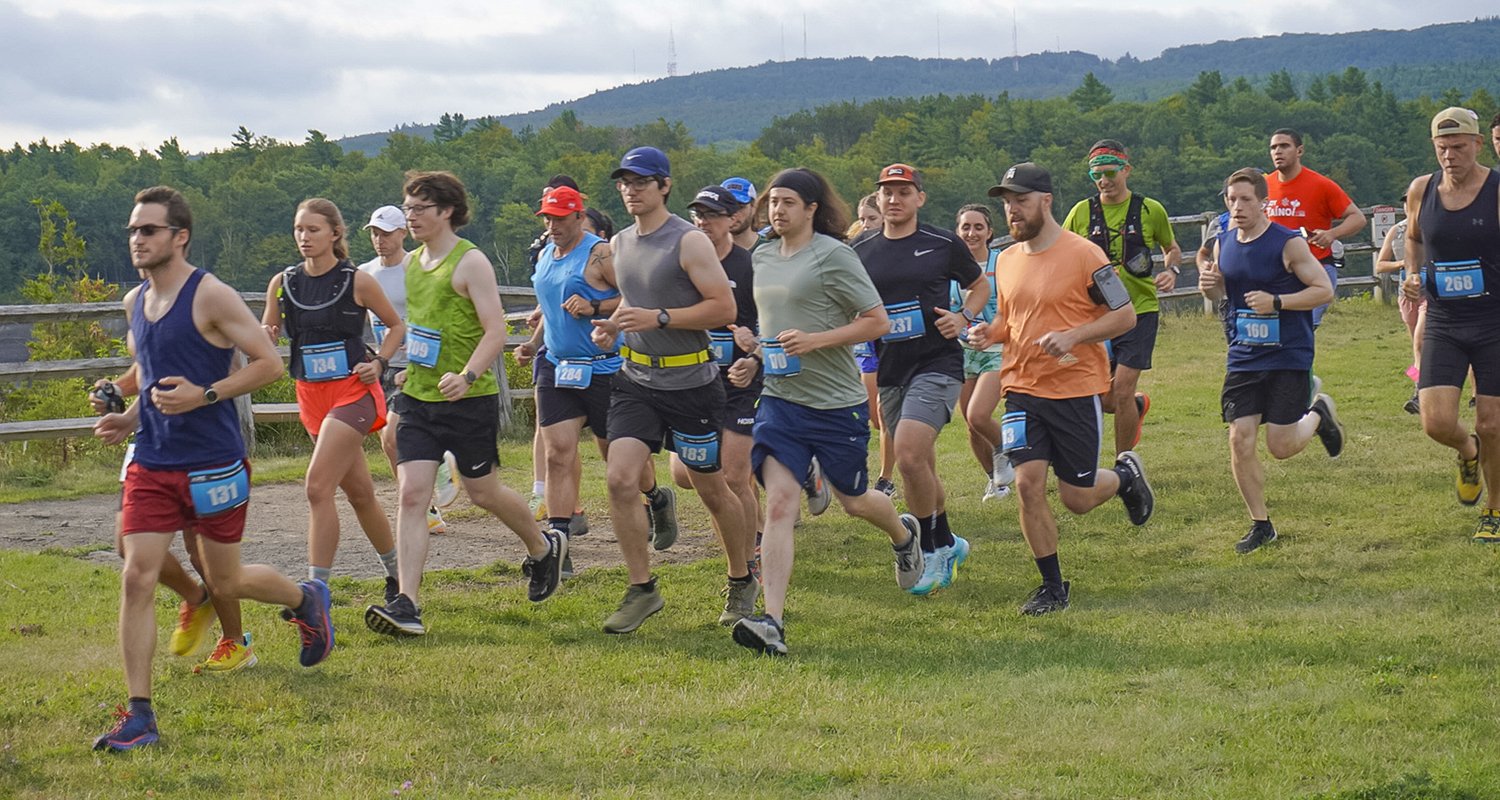
Field start of the 2025 Thacher Park Trail Running Festival. AREEP
Fall Distance Racing
Many Superb Opportunities!
By Megan James
Adirondack Marathon begins for 4:15 pacers in Schroon Lake. ASC
The dog days of summer are here! With the heat and humidity, it can be hard to envision running hard, chasing PRs, and tackling long race distances in just a couple of months. But the time and energy you put in now pays off down the road. There are many great races in the region, and some may serve well as tune-ups for later races. Check out this preview of some popular road and trail races, and a few summer training tips to get you to the start and finish lines!
First up, we have our late summer races. Taking place on Sunday, Aug. 23, Thacher Park Trail Running Festival, produced by ARE Event Productions, is held on a gorgeous course to enjoy Thacher State Park’s tranquil scenery, with some of it along the Helderberg Escarpment Trail. The 10K, 13.1M, 26.2M, and 50K start/finish at the same location, making it good for spectators as well. Enjoy the festive atmosphere and post-race food as you watch runners from the other distances come into the finish: areeventproductions.com.
On Saturday, Sept. 5, Run 4 the River Half Marathon is back. It has a net downhill course along the Mohawk River on the Empire State/Erie Canalway paved trail from Mabee Farm in Rotterdam Junction to Frog Alley Brewing in downtown Schenectady. This fast half can be used as a test of fitness or a half or full marathon tune-up. The post-race party takes place at the brewery, where you’ll find hot and cold foods, beverages, and live music. While different in terrain, Thacher and R4TR offer quality, organized opportunities for competitive to recreational runners: narkrunningstrength.com.
Next, head north to the Wilcox Wild Ultra 50K, a rugged 31M trail race on Sunday, Sept. 6. It’s held in the Wilcox Lake Wild Forest in the southeastern Adirondacks. Aside from training to spend multiple hours on the trail, it’s essential to have several training runs on trails prior so you are comfortable, confident, and safe. Starting at Harrisburg Lake, the wilderness course takes you deep into technical singletrack, remote lakes and beautiful trails: wilcoxwild.com.
The Bagel Run (formerly Dunkin and Bruegger’s) is back on Sunday, Sept. 20. As the Albany Jewish Community Center celebrates 100 years, they’re bringing back this tradition with the 5K Run/Walk, 10K and 15K races, and 1K Kids Run. There’s something for everyone on the neighborhood courses that brings the community together, while raising funds to create meaningful impact for kids, families, and older adults throughout the year: albanyjcc.org.
The Adirondack Marathon & Half Marathon on Sunday, Sept. 27 offers a full, half, and two- and four-person relays. On Saturday, Sept. 26, there are 10K and 5K races in Chestertown, hosted by the Chestertown Rotary. On Sunday, Sept. 27, the full course goes around Schroon Lake (with Pacer Bears to hit your goals), and half around the southern half of the lake – the views are breathtaking, and the hills are challenging. I find a bit of undulating terrain helpful in longer races, because it’s similar to what I train on at home, so you may actually find it easier than running a fully flat course: adirondackmarathon.org.
When we get to October, the options really open up as the leaves fall down. If you’re looking for an adventure that supports a worthy cause but aren’t quite sure about the ultra-distance, Flutters & Foliage on Saturday, Oct. 3 is a great option. There are no DNFs at this race, and it benefits Flutters of Hope, a non-profit that helps individuals and families affected by eating disorders. It is staged at Peebles Island State Park in Waterford on a two-mile flat trail loop. You can sign up for a six-hour solo or three- or six-person relay, three-hour solo, or one-hour solo option, whichever works best and you can complete as many laps as you’d like. For a challenge, complete at least 50K to earn a belt buckle: fluttersofhopeinc.org.
The following weekend, you can select from a double-header. The Lake Placid Classic on Saturday, Oct. 10 offers half marathon (13.1M), 10K, and 5K run/walk on a beautiful course, staged from the Horseshow Grounds, primed for leaf-peeping, and benefiting local youth organizations. There are a couple of hills in these courses, but they pale in comparison to the Olympic ski jumps and stunning High Peaks views that will be surrounding you: lakeplacidclassic.com.
Exiting Vale Cemetery at the MVP Stockade-athon 15K. HMRRC
Mohawk Hudson River Marathon & Half Marathon on Sunday, Oct. 11, well-organized by Hudson Mohawk Road Runners Club, offers 26.2M and 13.1M distances on courses that are paved along the beautiful Mohawk-Hudson/Empire State Trail. These are historically very fast races, with some people even qualifying for the Olympic Trials here. Plus, it’s a great Boston qualifier. Runners in both races are cheered on by local high school XC and track teams at the water stops along the route. The course uses 18 miles of paved bikeways along the Mohawk and Hudson rivers, the finish is at the Corning Preserve Boat Launch in Albany. The full is from Schenectady to Albany (with race pacing available) and the half is from Colonie Town Park to Albany: mohawkhudsonmarathon.com.
For scenic routes with views of the Green and Adirondack mountains, consider the Middlebury Maple Run on Sunday, Oct. 18. It’s Vermont’s sweetest half marathon (13.1M), 10K and 5K, with a mix of trail, paved, and dirt roads for all distances. There’s inspiring music on course, with pacing services available, a post-race breakfast, and Vermont maple syrup for top finishers: middleburymaplerun.com.
For those looking to snag a fun, mid-fall trail race, check out Hairy Gorilla Half & Squirrelly Six on Sunday, Oct. 25 at Thacher State Park. These 13.1M and 6M trail runs are “part running race, part costume party” so be sure to wear your best outfit and try to escape the costumed volunteers. These courses are similar to the Thacher Trail Running Fest in August, so while trail races are difficult to compare, you could get a good idea of summer-to-fall gains by running both: areeventproductions.com.
Cruising along at the Mohawk Hudson River Marathon. HMRRC
Getting deeper into the fall season, November comes into view. The 50th running of the MVP Health Care Stockade-athon takes place on Sunday, Nov. 8 – it’s one of the oldest 15Ks in the U.S. HMRRC’s classic race gets first billing on my race calendar every year as one of my all-time favorites, visiting Schenectady’s historic Stockade district, beautiful Central Park, and historic Vale Cemetery. It has a flat start and downhill finish (which means, yes, there is some climbing in between), great prizes and nice shirts, and you can peruse the Green Market before or after heading indoors for the post-race party: stockadeathon.com.
The Upstate Classic 13.1M & 5K are on Sunday, Nov. 15. Staged from the spacious Altamont Fairgrounds, a few miles outside of Albany, entreats you to a gorgeous course at the base of the Helderberg Escarpment around rural Guilderland. There are also kids races: areeventproductions.com.
Training Tips
By now you’ve selected which races you’re going to run this fall, and it’s time to get started on your training! Summer is a great time to enter into “base mode” which means you are simply logging time to lay the foundation for higher-level things like race-pace intervals and longer long runs. This is the time to build your consistency and volume while addressing any lingering injuries, nutritional deficiencies, or other challenges from previous seasons. You can run a decent mid-distance race with as little as three to four training days or 20 miles a week, so don’t feel pressured to run every day or tons of miles. I always opt for consistency, health, and enjoyment over pure volume or intensity; if you have a coach, make sure you’re on the same page with goals and values. With training at any level, it’s important to build in down weeks – a relative drop in volume (could be up to 50%) every three to six weeks – to allow your body to “catch up” with training and minimize your risk of overuse or bone injuries.
Incorporate these three types of runs into your training on a weekly or biweekly basis: long run, tempo run, strides.
Long runs – I generally recommend matching the total time of your long run to the expected finish time of your race, at a slower pace (at least one minute per mile slower), regardless of distance covered: a 2:10 half marathoner would max out in the vicinity of two-hour long runs. If you are expecting to finish a race in over three hours, you can and should incorporate some walking into the long run so that your total running time is about three hours, but the total time on your feet might be four to six hours.
Tempo runs – These are essential for developing your tolerance for a little discomfort and recycling the byproducts of the aerobic energy system. The standard tempo run is 20-22 minutes at an effort that you could sustain for a one-hour race, which tends to be roughly 30-40 seconds slower per mile than your 5K race pace.
Strides – To help open your stride and “feel fast” when already tired, strides can be tacked on at the end of a base or long run. I recommend four to six times of 15-20 second mile-race efforts with 30-60 seconds of recovery, twice a week.
Account for summer weather – I can almost guarantee that your runs will be slower on the hot and humid days, and that’s okay! With higher humidity, our sweat doesn’t evaporate from our skin, making our bodies less efficient at cooling. Similarly, with a high dewpoint, the air is closer to saturation and it feels “sticky” or “muggy.” Early mornings tend to be more humid, but later in the day is hotter; so you have to choose which one is more tolerable – I find that running around 7am is the hardest because the humidity is still high and the temperature is rising rapidly. Base your training runs on effort rather than pace: if your perceived effort is greater than 4/10 on a base or long run, you’re probably working too hard; a tempo run should be about 7-8/10.
Practice for race day – Understand what works for your body with nutrition, hydration, clothing, and footwear. Practice this during your training runs because it’s much better to experience GI distress or chafing during a training run so you have a chance to adjust things before race day. Fueling and hydration are important aspects of the run itself and recovering before the next workout. If you’re driving to meet with friends, don’t forget to pack the post-run snacks – recovery mode starts as soon as you’re done running!
Most importantly, have fun! – It can be hard to get yourself out the door or to the treadmill after a long day or on a steamy morning. Focusing on the process versus strictly the outcome can be helpful, as is setting small goals to lead to bigger targets. Mix up running solo and with friends or a local group/club. Laugh, learn from busted workouts, check out new routes/trails, soak up the sunshine, and take a minute to appreciate that your body and mind allow you to do amazing things!
Megan James (megan@ptimmersion.net) of Charlton is a running specialist physical therapist and certified running coach. She is an avid runner, with special interest in 15K to half marathon distances, and loves tempo runs! Learn more: ptimmersion.net.